
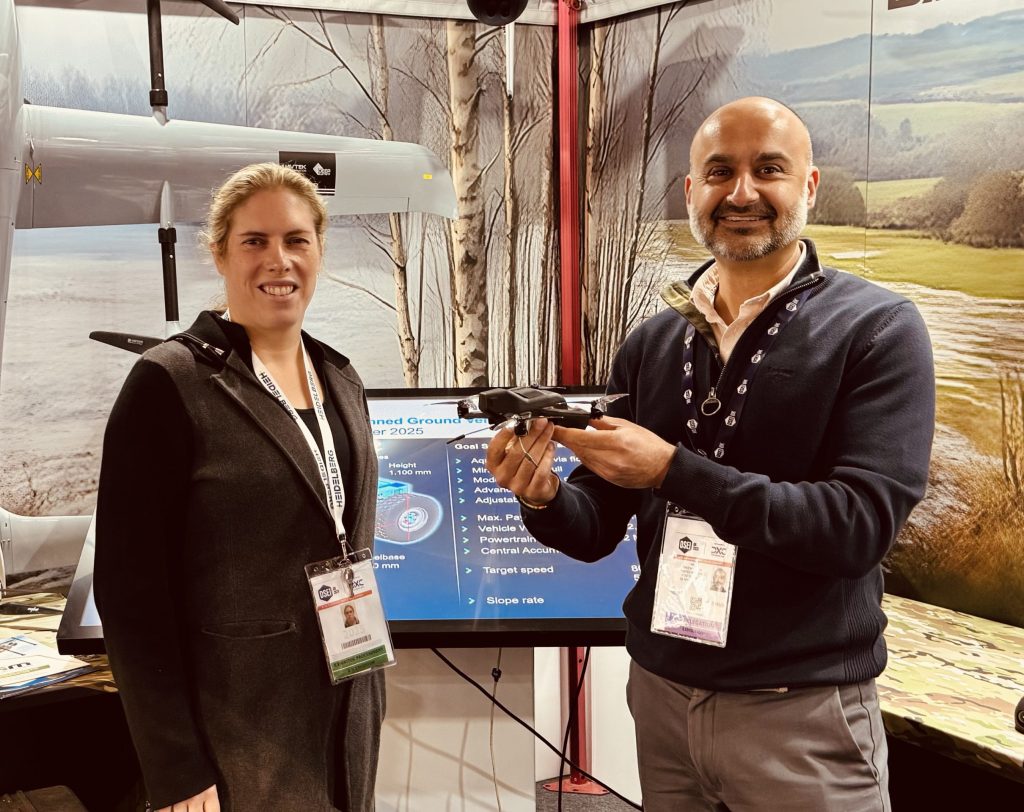
Last year at DSEI UK 2025, one thing that really stood out to us was just how quickly drones have moved from being seen as niche technology to becoming part of everyday life. The pace of development across the sector was hard to ignore, and it was clear that drones are no longer limited to specialist military or industrial use cases.
Today, drone technology is being applied across a huge range of industries. We are already seeing commercial delivery services being trialled around the world, while drones are increasingly being used for survey inspections, infrastructure monitoring and environmental data collection. In emergency response situations, drones are helping first responders assess incidents more safely and quickly, often providing critical information before people are sent into dangerous environments. Of course, defence applications also continue to evolve rapidly, with autonomous systems and advanced aerial capabilities becoming an increasingly important part of modern military operations.
What was equally interesting at DSEI was seeing how many companies from completely different sectors are now moving into the drone industry. It highlighted how accessible and commercially important the technology has become, and how organisations are beginning to recognise opportunities outside of their traditional markets.
One example that caught our attention was Heidelberger Druckmaschinen AG, better known as Heidelberg. Historically associated with printing and packaging technology, the company has now moved into drone design and manufacture. On the surface, printing and drones may seem worlds apart, but when you look closer, it starts to make sense. Companies with expertise in precision engineering, advanced manufacturing and electronics already possess many of the core capabilities needed to transition into emerging technology sectors.
That crossover between industries feels like something we are going to see more and more over the next few years. Technology is evolving so quickly that the boundaries between sectors are starting to blur. Businesses that once operated in very defined spaces are now finding opportunities in entirely new markets, often by adapting skills and knowledge they already have.
At LAB287, that idea of combining capabilities is something we think about a lot. Alongside our work in space-enabled transformation, we also have expertise in software engineering, electronics and artificial intelligence. Individually, each of those areas has huge potential, but when they are brought together, the possibilities become even more exciting.
Whether it’s using AI to process data from autonomous systems, combining electronics and software to build smarter connected devices, or integrating space-enabled insights into real-world operational challenges, there is enormous potential for innovation. Some of the most interesting solutions often happen at the intersection between technologies rather than within a single discipline.
It is an exciting time to be involved in emerging technologies, particularly in areas like drones, autonomy and intelligent systems, where change is happening at such a rapid pace. If you would like to know more about what we do at LAB287, or if you have an idea you are looking to get off the ground, we would love to hear from you.
LAB287 is the UK’s leading specialist in space-enabled organisational transformation. We help government and public sector bodies, as well as businesses in the private sector, to implement change by putting to work the capabilities and potential of data and technologies originating or located in space.
